
Filming at the Château de Versailles: What Productions Need to Know
Twenty years after Sofia Coppola's "Marie Antoinette", here is what it takes to shoot at the world's most famous palace.
The Château de Versailles won't close its doors for a film crew. It didn't close them for Sofia Coppola either.
This autumn the palace is marking two decades since "Marie Antoinette" (Columbia Pictures, 2006). From 22 September 2026 to 24 January 2027, an exhibition at the Petit Trianon, designed in collaboration with the director, looks at the film's genesis, its aesthetic choices and its cultural impact.
In the film, Kirsten Dunst plays a 14-year-old Austrian archduchess sent to Versailles to marry the future Louis XVI. Coppola's crew got rare access to the palace and its estate. Here's what filming there involves, then and now:
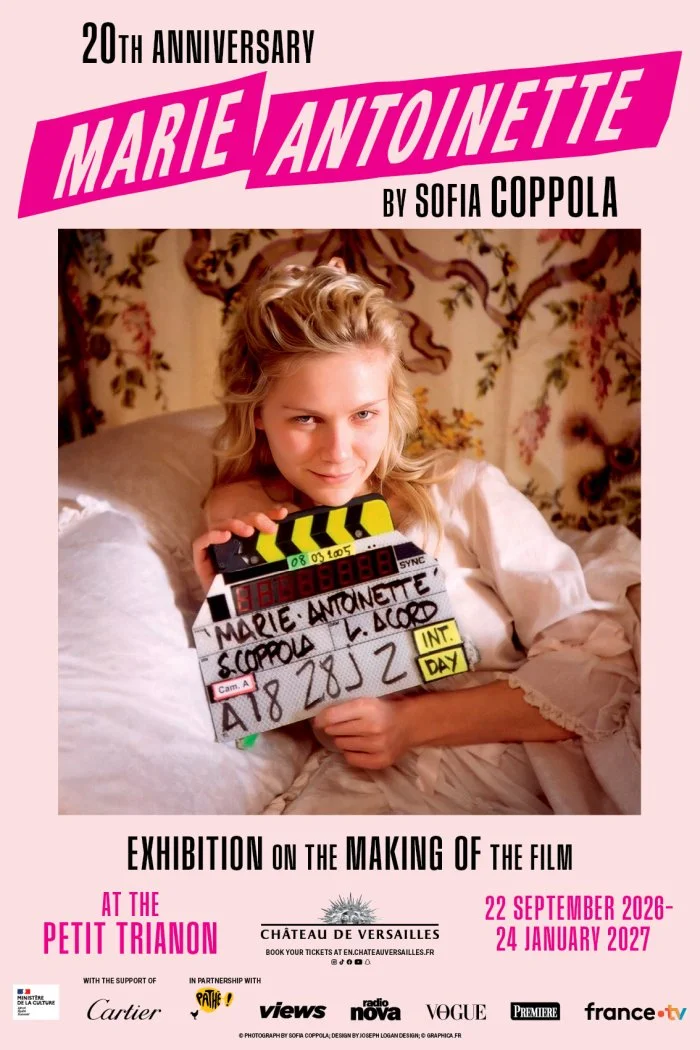
Poster for “Marie-Antoinette “ film exhibition at the Petit Trianon © Château de Versailles
1. Scheduling: Mondays and nights
The first thing to know is that Versailles is a museum before it is a film set. The palace says it never closes for a shoot, because welcoming the public remains its priority; hosting productions is a side activity.
In practice, shoots take place when the site is closed to visitors, which mostly means Mondays and nights. Crews arrive on Sunday evening and must leave once filming ends, before the site reopens. If you need more than one day, you come back the following week. Space is limited too: the palace hosts between one and six fiction projects a year, and a single project can last anywhere from one day to 19.
2. A demanding environment
Space: Versailles was built to impress a royal court, not to accommodate camera dollies. The corridors are cramped and the routes into many rooms wind through the building.
Time: You are also not the only one asking for dates. The palace fits shoots around its own calendar of restorations, events for patrons and school visits, and the main factor in its decision is whether the spaces are available.
Signs: Period productions face an extra task. Because the palace is open to the public, it is full of signage, and for historical films these contemporary elements regularly have to be hidden.
3. More than the palace itself
Filming at Versailles covers much more than the Hall of Mirrors. The estate includes the gardens, the Grand and Petit Trianon, the Hameau de la Reine and the Grand Canal. For "Marie Antoinette", the Petit Trianon, a place closely tied to the queen, served as the setting for many sequences.
Coppola also looked beyond the estate. Scenes were filmed at the Opéra Garnier in Paris and at the Châteaux de Chantilly and Vaux-le-Vicomte. Each of these sites has its own management and its own rules. For many productions, combining Versailles with nearby châteaux is the only realistic way to get the look they need within the palace's limited availability.
4. Knowing who to ask
Versailles is not one permit but several, depending on where the camera is.
The estate (palace, gardens and Trianon) has its own film office, which handles shoots directly.
The streets of Versailles fall under the Ville de Versailles, whose events service handles filming requests in town.
National roads outside town are a matter for the Préfecture des Yvelines. The prefecture asks for requests at least one month before the shoot date, with details such as dates, locations, crew size, equipment, a synopsis and insurance.
A single project that combines an establishing shot on the Avenue de Paris, a scene in the gardens and a car sequence on the approach roads can therefore need three separate authorizations, each with its own lead time.
5. Brand content is a different conversation
Documentaries, features and TV fiction are the palace's usual guests. Brands can film too, but the route is different. The palace says it may consider promotional films through partnership agreements with its teams. Expect a longer discussion about the project, its image and the relationship with the institution, rather than a simple location booking.
Before you make the request
Whatever your format, you'll move faster if you arrive with a clear dossier: a short description of the project and its broadcaster or client, preferred dates with fallback Mondays, the spaces you need, crew size, an equipment list and proof of insurance. Start early. The palace's calendar fills up with restorations and events well in advance, and the other permits in and around Versailles each have their own lead times.
Filming at Versailles with Fab Fixers
Since 2014, Fab Fixers has provided production services across France and Belgium for international broadcasters, streamers and brands. We handle location scouting, permits, scheduling and on-the-ground coordination, so your team can focus on the story.
Planning a documentary, feature or brand shoot at Versailles or in the châteaux of Île-de-France? Get in touch:
virgile@fabfixers.com
+33 6 22 99 43 50