
How to film in Paris - Permits, Locations & Insider Tips
By Virgile Demoustier, FAB FIXERS | Updated March 2026
Paris is one of the most filmed cities on earth. It is also, without question, one of the most administratively complex places to film in. International crews arrive assuming that the city's openness to tourism translates into openness to cameras. It does not. Getting it wrong costs days and budgets that productions cannot afford to lose.
I've been fixing shoots in Paris since 2014 — for PBS, BBC, CBC/Radio-Canada, National Geographic, the Washington Post, Delta Air Lines, the NBA, and many others. This guide contains everything I've learned about how to film in Paris without losing your mind, your schedule, or your budget.
The golden rule: start earlier than you think you need to
Everything else in this guide flows from this. Paris is permit-heavy, bureaucracy-layered, and unforgiving of late applications. The city's filming permit system has been tightened progressively — most recently in September 2024, when the deadline for all permit applications was standardised at 15 working days (three calendar weeks) across all arrondissements. That deadline is firm. Applications that do not meet the three-week deadline may be refused outright — no extensions, no exceptions for foreign productions.
For a shoot requiring multiple locations, multiple permit types, and parking authorisations in central Paris, I'd recommend allowing six to eight weeks from brief to shoot date. For news and current affairs with a single location and small crew, 48 to 72 hours is sometimes possible — but only if you know exactly who to call and how the system works.
If you're reading this the week before your shoot, call us immediately: +33 6 22 99 43 50.
Understanding the Paris permit system: two tracks, one platform
Paris operates a two-track permit system. Which track you need depends entirely on your crew size and what you're doing.
Track 1 — Prior declaration (small crews only)
If you are shooting with a total crew of fewer than 10 people, using light equipment only (shoulder camera, steadycam, reflector, spotlights), in streets and on bridges only — not in parks, gardens, on the Seine, at monuments, or at any other specific site — with no parking requirements, no drones, and no traffic management, you may file a prior declaration rather than a full permit application. Prior declarations are free and receive a registration number equivalent to an authorisation.
This sounds broader than it is. The moment your shoot touches a park, a garden, a canal bank, the Seine, a bridge with parking, a monument, or any location other than a public street or footbridge — you are on Track 2. When in doubt, assume Track 2.
Track 2 — Full permit via AGATE
AGATE (Autorisation de Gestion des Autorisations de Tournage et d'Événements) is the City of Paris's digital permit platform and your mandatory gateway for any production beyond the smallest declaration. The AGATE platform requires your synopsis, insurance certificate (minimum €2M civil liability), technical rider, and detailed implantation plans using the official CapGéo guide.
As of January 2025, all filming permit applications in AGATE must be accompanied by the signed VHSS Charter — a formal commitment to the city's charter against sexual and gender-based violence on set. Without this charter attached to your submission, your application will not be processed. This catches a lot of foreign productions by surprise. Make sure it's in your dossier from day one.
Who manages what:
Paris Film — the City of Paris film office — is the single point of entry for permits in public spaces managed by the city: streets, bridges, parks, gardens, the Bois de Boulogne, the Bois de Vincennes, canals, riverbanks, and markets.
Paris Film does not issue permits for the Eiffel Tower, the Arc de Triomphe, the Louvre, the Tuileries Gardens, the Garnier Opéra, the Luxembourg Gardens, the Musée d'Orsay, or La Défense. Each of these iconic locations has its own management body, its own application process, and its own fee structure. See the section on iconic locations below.
What you need in your permit dossier
For a standard AGATE application, prepare the following before you submit:
Mandatory documents:
Synopsis of the production (one page is sufficient for most documentary and news shoots)
Insurance certificate — minimum €2M civil liability, valid for France
Technical data sheet — crew size, equipment list, vehicle count
Implantation plans — site layout maps using the CapGéo base plan format
Signed VHSS Charter (mandatory since January 2025)
For parking and traffic requests additionally:
Detailed parking plan
Vehicle list with dimensions
Confirmation that you are not requesting spaces on streets closed to parking
Road closures and use of public streets for filming require coordination with local authorities, and major thoroughfares or streets in sensitive areas may have stricter conditions. Arrondissements under particular tension for parking — the 1st, 4th, 5th, 6th, 7th, 9th, 10th, and the Butte Montmartre in the 18th — require parking bylaws in addition to the standard permit, which adds administrative time. Note also that as of January 2025, the Préfecture de Police has requested that no filming take place within the Champs-Élysées perimeter until further notice.
Filming at Paris's iconic locations — the truth
This is where most foreign productions get into trouble. They assume that because Paris is open and beautiful, its most iconic locations are freely accessible. They are not. Here is the reality, location by location.
The Eiffel Tower
The Eiffel Tower exterior — the esplanade, the Champ de Mars — falls under Paris Film's jurisdiction and can be permitted through AGATE. Filming inside the tower, at height, or for commercial purposes requires a separate authorisation from the Société d'Exploitation de la Tour Eiffel (SETE). The Eiffel Tower when lit at night is also subject to copyright held by the architect's estate — this applies to any image where the tower's light show is captured, even incidentally, in commercial content. Night shoots at the tower require both the SETE authorisation and specific handling of the intellectual property question. This is not a technicality to be dismissed: it has cancelled shoots.
The Louvre
The Louvre exterior (the pyramid and surrounding courtyard) is managed by the Établissement public du musée du Louvre, entirely from Paris Film. Interior filming requires a specific agreement with the Louvre's film department — lead times of several months are normal for interior access. The famous glass pyramid can be filmed from the public exterior without interior access, but parking and crew management still require AGATE.
Notre-Dame-de-Paris
Notre-Dame reopened in December 2024. Access for filming — particularly interior access — requires coordination with the cathedral authorities and, for anything beyond standard visitor-level coverage, institutional relationships. FAB FIXERS secured exclusive construction site access for CBC News ahead of the reopening; this kind of access is a function of trust built over years, not a standard permit application.
Montmartre and the Sacré-Cœur
Montmartre is a residential hill, not a theme park. The streets around the Sacré-Cœur Basilica generate enormous volumes of permit applications from productions wanting the quintessential Paris rooftop view. The Butte Montmartre in the 18th arrondissement is classified as an area under parking tension, meaning parking bylaws are required in addition to standard permits. Expect pushback from residents if your crew is large or your schedule runs into evenings.
Versailles
Versailles is outside Paris proper and managed by the Château de Versailles independently. Filming in the palace, the gardens, or the Grand Trianon requires a direct agreement with their audiovisual department. Fees can be substantial for commercial productions. For documentary and news use, the process is more accessible — but still requires advance planning.
Special permit categories: drones, night shoots, fake weapons
These three categories require additional steps beyond the standard AGATE process and catch out foreign productions constantly.
Drones
Drone filming in Paris is heavily restricted. The city centre — everything within the périphérique — is a no-fly zone for commercial drone operations. Drone shoots require specific authorisation and cannot be included in a standard AGATE declaration. The process involves the Direction Générale de l'Aviation Civile (DGAC) and, for many Paris locations, is simply not possible regardless of how long you wait or how much you're prepared to pay. If drone footage of Paris is essential to your production, the realistic options are pre-existing licensed aerial footage or helicopter-mounted cameras — both of which we can arrange.
Night shoots
Filming at night after 11pm requires specific authorisation beyond the standard permit to respect the peace and quiet of local residents. This is not a formality — Paris takes residential very seriously, and night shoot applications in residential arrondissements receive scrutiny. Early morning hours may also require special approval and are subject to additional noise regulations. Build extra lead time into any schedule that includes night sequences.
Fake weapons and special effects
Since early 2025, shooting effects — meaning pyrotechnics and any explosive or firearms simulation on location — have been banned throughout the capital. This is a significant change that affects action and drama productions. Fake weapons that are visually realistic require notification to the Police Prefecture and must be managed by certified personnel on set. Actors in police or military costume must remain at the filming location at all times to avoid confusion with real officers. All sound effects simulating police intervention — gunshots, whistles — are prohibited on public roads and must be done in a studio environment.
Practical location guide: where to film and what to expect
Beyond the iconic landmarks, Paris offers an extraordinary range of locations for international productions. Here are the ones we work with most frequently and what you need to know about each.
The Seine and its bridges
The banks of the Seine and its bridges are among the most filmed locations in Paris and, logistically, among the most manageable. Paris Film handles authorisations for bridges and the riverbanks through AGATE. Pontoon access and filming from the water requires additional coordination with the Port Autonome de Paris. The Seine's bridges vary significantly in their permit complexity — the Pont des Arts and Pont Alexandre III attract the most applications and the most scrutiny.
Parks and gardens
The Bois de Boulogne, Bois de Vincennes, Parc Monceau, and Champ de Mars all fall under Paris Film's jurisdiction and can be permitted through AGATE. The Luxembourg Gardens and the Tuileries are managed separately — the Luxembourg by the Sénat, the Tuileries by the Louvre. Lead times and fees vary accordingly. Parks in residential arrondissements impose time restrictions on equipment setup and breakdown.
Haussmann interiors and private buildings
Some of the most arresting locations in Paris are private — Haussmann apartment buildings, private hôtels particuliers, covered passages, and historic interiors that rarely appear on public permit maps. Access to these requires direct negotiation with owners or syndics, often supplemented by location fees. FAB FIXERS maintains a network of private location contacts built over a decade. Even when filming on private property, if your shoot requires parking equipment on public streets or managing pedestrian flow, additional city permits are required.
La Défense
La Défense is technically not within Paris proper — it is administered by the Établissement Public d'Aménagement de La Défense (EPADESA), not the City of Paris. Permits here go through a completely separate system. The good news: the Grande Arche and its plaza offer extraordinary architectural footage with less competition than central Paris locations.
Bringing equipment into France: customs and carnets
For non-EU productions, professional filming equipment entering France temporarily must be handled correctly at customs.
The simplest route is an ATA Carnet — an international customs document that allows professional equipment to be exported duty-free to over 87 countries for up to one year. If you don't have an ATA Carnet, you must file a Simplified Application for Temporary Admission (the "Bona fide" process) at customs on arrival, presenting your equipment list, the authorisation from the regional customs directorate, and contact details for a French correspondent. Upon arrival, journalists must report to customs at the airport with their equipment. This process is fast when prepared correctly — and a disaster when it isn't.
For non-EU film crew on projects of three months or less, no individual work permit is required. However, the employer must submit a SIPSI declaration before the start of the shoot. This is a legal requirement that is frequently overlooked by international productions and creates compliance exposure. FAB FIXERS manages SIPSI declarations for all foreign crews we work with.
Insurance: the non-negotiable
Insurance is required in all cases — even for a B-roll shoot. Paris Film requires proof of insurance with your AGATE application, and the minimum is €2M civil liability. For productions involving vehicles, stunts, night shoots, or high-profile locations, the appropriate level is higher. French insurers and international film insurers with French coverage can both work — what matters is that the policy explicitly covers filming in France and that the certificate is in a format the permit office will accept. We can recommend reliable providers for foreign productions.
What nobody tells you: the unwritten rules
Permit approval is your legal baseline. What actually determines whether you can keep coming back to film in Paris — and whether residents, shopkeepers, and local authorities cooperate with your crew — is how you behave on location.
Filmmakers are required to notify local residents and businesses of any shoot involving significant disruption, distributing leaflets or letters informing them of the schedule and any disturbances. This notification must happen in the three days before filming. The mandatory QR code notice system introduced in 2025 formalises this. Do it properly, not as an afterthought.
Beyond the legal requirement: introduce yourself to shopkeepers on the street. Manage noise proactively. Leave every location in better condition than you found it. Paris has a long institutional memory for productions that treat the city as a backdrop rather than a community. Your permit for next time depends on your behaviour this time.
Working with a Paris fixer: what to expect and when to bring one in
The honest answer to whether you need a fixer in Paris: for any production beyond a solo journalist with a camera, yes. The permit system, the institutional landscape, the network of private contacts, the on-set logistics, the language — all of it is faster, cheaper, and less risky with someone who does this full-time.
The question is when to bring them in.
For documentary and branded content: as early as possible, ideally at brief stage, before locations are fixed. Locations that seem perfect from Google Street View are sometimes unpermittable — or permittable but prohibitively expensive. A fixer who knows the system can tell you in 20 minutes which of your shortlisted locations will work and which will blow your schedule.
For news and current affairs: the moment you know you have a Paris assignment. A good fixer is reachable and can mobilise resources before you land.
FAB FIXERS provides fixing and production services across Paris and all of France. We've been on the ground since 2014, working with broadcasters, documentary makers, and global brands on productions of every scale. If you're planning a shoot in Paris, we'd love to hear about it.
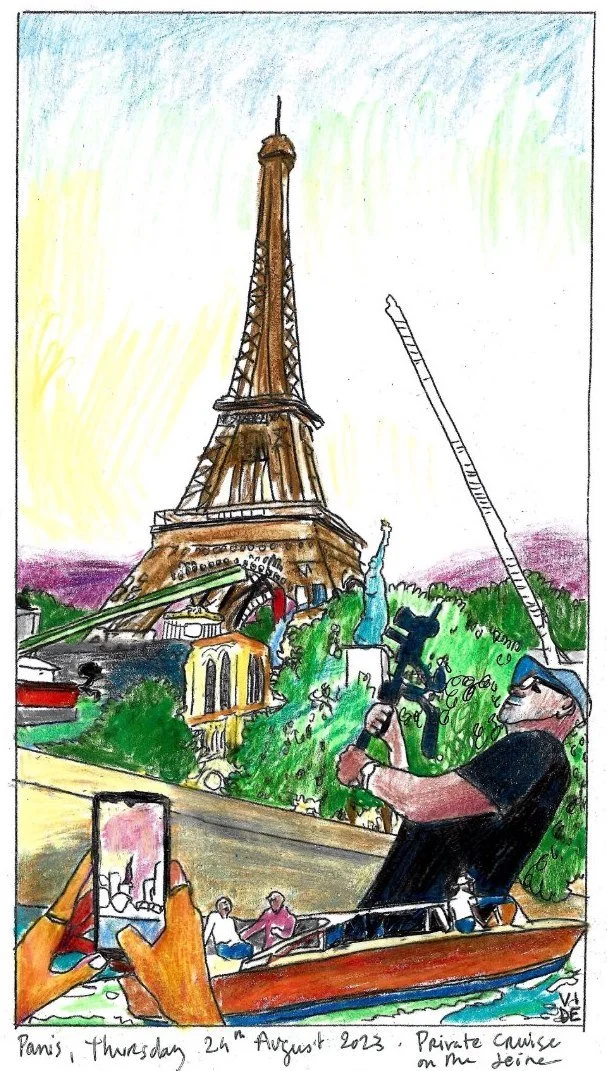
Filming in Paris with Delta Air Lines, August 2023
Paris filming permit checklist
At brief stage:
Confirm locations and assess permit complexity
Check whether AGATE or prior declaration applies
Confirm insurance coverage and level
Arrange ATA Carnet or Bona fide customs process for equipment
Six to eight weeks before shoot:
Compile full AGATE dossier (synopsis, insurance, technical sheet, CapGéo plans, VHSS Charter)
Submit AGATE applications for all relevant locations
Begin any separate applications for iconic locations (SETE, Louvre, etc.)
Submit SIPSI declaration for non-EU crew
Three weeks before shoot:
Confirm all permit approvals
Address any queries from Paris Film promptly — delays in responding delay your approval
Book local crew
Three days before shoot:
Distribute resident notification leaflets / post QR code notices as required
Confirm parking and logistics with crew
Day of shoot:
Carry hard copies of all permits on location at all times
Ensure all crew are briefed on permit conditions
Manage noise and street presence proactively
Virgile Demoustier is the founder of FAB FIXERS, a Paris and Brussels-based fixer and production company. Since 2014, FAB FIXERS has supported international crews from PBS, BBC, CBC/Radio-Canada, National Geographic, the Washington Post, Delta Air Lines, the NBA, and many others across France and Belgium.
Planning a Paris shoot? Contact us at virgile@fabfixers.com or +33 6 22 99 43 50. We respond within the day.